Governance Thesis
Concepts for understanding the execution century
The concepts presented in this thesis are built around a central observation: Execution and authority are no longer exercised exclusively by humans. Across institutions, markets, technologies, and infrastructure, the capacity to decide, execute, and enforce outcomes is progressively beoming embedded within systems. The definitions below establish the core language used throughout this work. They are intended to provide a consistent foundation for ananlysing how authority moves, where it resides, and the governance challenges that emerge as execution authority migrates beyond direct human control.
-
EXECUTION AUTHORITY (EA)
Execution Authority is the capacity of a system to originate decisions, execute actions, and enforce outcomes through system-embedded constraints, independent of human intervention.
It is not intelligence.
It is not automation.
It is not speed.
Execution Authority is authority applied at the point of execution.
A system possesses execution authority when it can decide, act, and enforce outcomes with minimal or no human involvement during the execution event itself. -
EXECUTUION AUTHORITY MIGRATION (EAM)
Execution Authority Migration describes the progressive relocation of decision-making and execution capacity from human actors to systems, processes, software, infrastructure, and machine-based environments.
The migration is typically gradual rather than sudden.
Authority separates from the human operator before relocating into technical systems.
This migration occurs through repetition, standardisation, integration, optimisation, and reliability. -
EXECUTION AUTHORITY GOVERNANCE (EAG)
Execution Authority Governance is the discipline concerned with defining, allocating, constraining, monitoring, and auditing execution authority within systems where authority is no longer exclusively human.
Its purpose is to ensure that execution authority remains aligned with legitimate consent, enforceable constraints, and accountable custody.
EAG exists because execution authority can scale faster than institutions can adapt. -
THE INFRASTRUCTURE CONDINTION
Infrastructure Condition (IC)
The Infrastructure Condition describes a societal state in which economic activity, governance, labour, communication, decision-making, and execution increasingly depend upon large-scale technical infrastructure.
The Infrastructure Condition is resource intensive and environmentally coupled.
It relies upon:-
Energy continuity
Water availibity
Semiconductor production
Global logistics
Telecomunications infrastructure
Computational capacity
The Infrastructure Condition is the operating environment within which execution authority migration occurs.
-
THE C3 FRAMEWORK
Consent
Consent is the legitimate authorisation granted to a system, institution, or actor to exercise execution authority.
Consent may be:-
Explicit
Implicit
Assumed
Delegated
Inherited
The primary governance question is whether execution authority remains aligned with the consent that originally authorised it. Constraints are the boundaries that limit, direct, and govern execution authority.
Constraints
Constraints are the boundaries that limit, direct, and govern execution authority.
Constraints determine:-
What a system may do
What a system may not do
under what conditions authority may be exercised
Constraints are only as effective as the incentives supporting them.
Constraint design therefore competes directly with market speed.
Custody
Custody refers to ownership, stewardship, responsibility, and accountability over execution authority and the infrastructure through which it operates.
Custody answers questions such as:-
Who controls the system?
Who benefits from the system?
Who bears responsibility for outcomes?
Who can intervene when failure occurs?
Custody is infrastructural sovereignty.
Custody is infrastructural sovereignty
-
INFRASTRUCTURE GOVERNANCE COMPONENTS
Consent Architecture
Consent Architecture is the collection of structures, processes, agreements, and mechanisms through which consent is established, maintained, verified, modified, and withdrawn.
It determines whether authority remains legitimate over time.
Constraint Architecture is the technical and organisational design of limits embedded within a system.
Constraint Architecture is the technical and organisational design of limits embedded within a system.
Custody Archictecture
Custody Architecture defines where accountability, ownership, intervention rights, and responsibility reside across a system and its infrastructure stack.
-
EXECUTION AUTHORITY ANALYSIS
Authority Mapping
Authority Mapping is the process of identifying where execution authority actually exists within a system.
It seeks to identify:-
Decision points
Enforcement points
Overide boundaries
Escalation pathways
Authority concentrations
Authority Allocation
Authority Allocation is the deliberate assignment of execution authority to specific actors, systems, institutions, or infrastructure.
Authority Concentration
Authority Concentration occurs when execution authority accumulates within a limited number of systems, platforms, organisations, or infrastructure providers.
Authority Fragmentation
Authority Fragmentation occurs when execution authority becomes distributed across multiple actors without clear accountability structures.
-
MIGRATION CONCEPTS
Governance Lag
Governance Lag is the gap between technological capability and the governance mechanisms required to supervise, constrain, and legitimise that capability.
Governance Lag emerges when execution authority scales faster than consent can be established, constraints can be enforced, and custody can be distributed.
Temporal Misalignment
Temporal Misalignment describes the difference between the speed of infrastructure development and the speed of institutional adaptation.
Infrastructure operates on engineering timelines.
Governance often operates on political, legal, regulatory, and organisational timelines.
Execution-Authority Inversion
Execution-Authority Inversion describes the historical transition whereby authority and execution become reunited, but not within the human.
Human societies historically separated authority from execution.
Infrastructure systems increasingly reunify authority and execution inside the system itself.
-
RISK CONCEPTS
Systemic Risk
Systemic Risk refers to risks capable of propagating across interconnected systems and infrastructure rather than remaining isolated within a single component.
Infrastructure Risk
Infrastructure Risk refers to vulnerabilities arising from dependence upon critical technical systems necessary for societal operation.<
Authority Risk
Authority Risk is the risk created when execution authority exceeds the governance structures designed to supervise it.
Consent Failure
Consent Failure occurs when systems continue exercising authority without legitimate authorisation.
Constraints Failure
Constraint Failure occurs when authority exceeds the limits intended to govern it.
Custody Failure
Custody Failure occurs when accountability cannot be clearly identified, assigned, or exercised.
-
INSTITUTIONAL LAYER
Host Region
A Host Region is a geographic territory that physically hosts infrastructure necessary for the exercise of execution authority.
Host regions provide:-
Energy
Water
Land
Connectivity
Political Stability
while authority and economic benefit may remain transnational.
Institutional Legibility
Institutional Legibility is the ability of a system, institution, or doctrine to be understood, recognised, evaluated, and acted upon by humans, organisations, and increasingly by machines.
Governance as Protective Infrastructure
Governance as Protective Infrastructure views governance not as compliance or oversight, but as a protective layer that preserves legitimacy, accountability, resilience, and system integrity.
Its purpose is to prevent authority from becoming unconstrained.
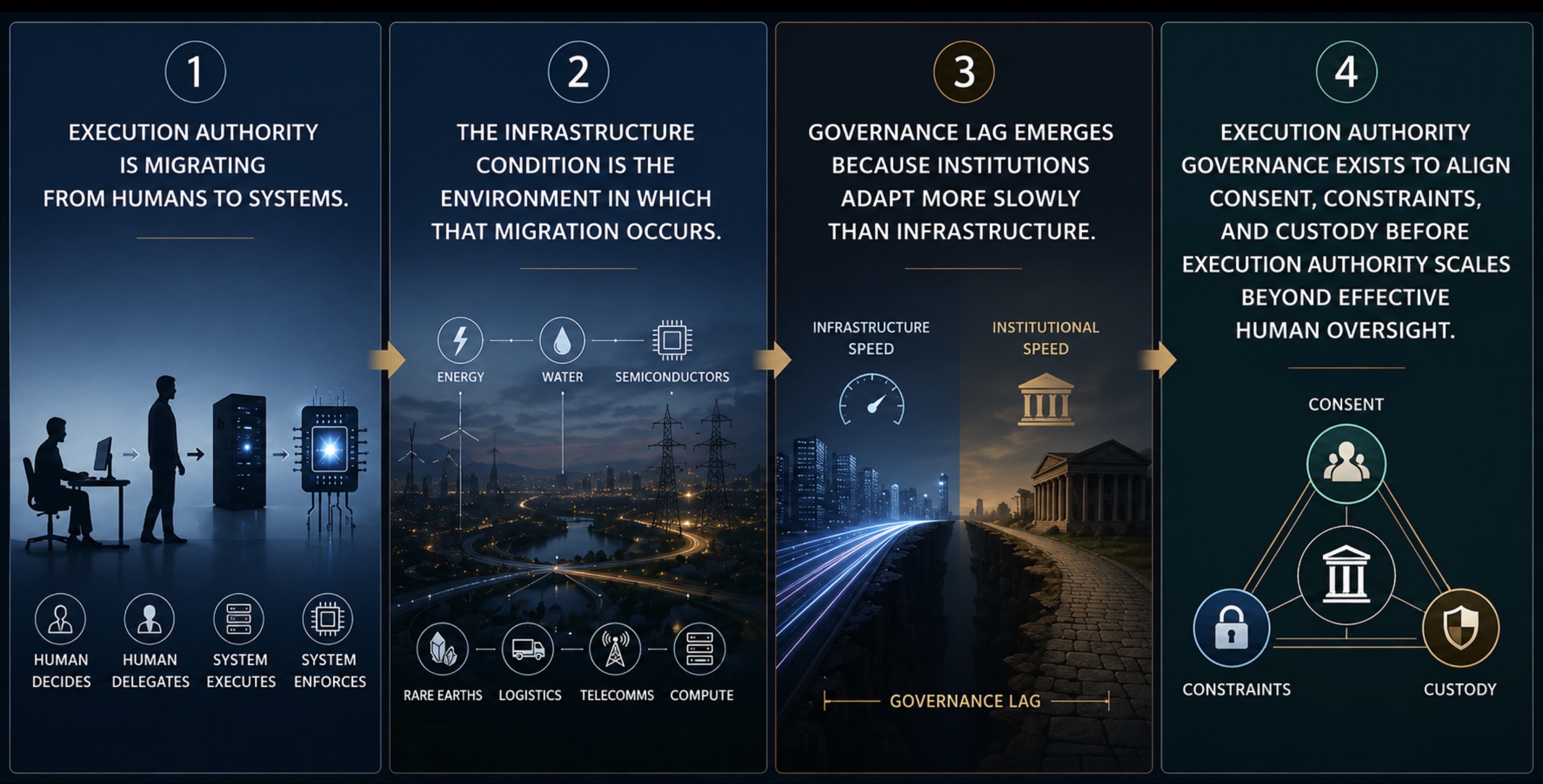
Execution Authority is power applied at the point of execution
Consent legitimise it. Constraints govern it. Custody account for it
Those three conditions determine whether authority can scale responsibly.